Journal
The bracelet
For the first six years the prize was a cup. Since 1976 the game has counted the gold.
September 2026 · 9 min
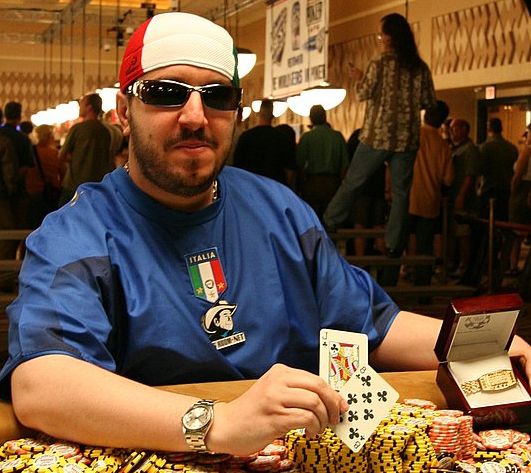
The metal is new. The argument about who is the best player is not.
1970, Binion’s Horseshoe, downtown Las Vegas. Benny Binion put the gamblers who already had the reputation in one room: Johnny Moss, Doyle Brunson, Amarillo Slim, Puggy Pearson, Sailor Roberts, Crandell Addington, Carl Cannon. It was not a freezeout the way we play one now. At the end the table voted. Moss was the champion. The prize was a silver cup. There was no bracelet to photograph.
The series stayed small. In 1971 it became a tournament. In 1972 the Main Event buy-in was set at $10,000, and it is still $10,000. The gold bracelet, the thing the record books count, starts in 1976. Before that the winners took silver cups and other trophies. Doyle Brunson won the Main Event the first year the bracelet existed, and he won it again in 1977.
Only four men have won the Main Event in consecutive years. Moss in 1970 and 1971. Brunson in 1976 and 1977. Stu Ungar in 1980 and 1981. Johnny Chan in 1987 and 1988. Only Moss and Ungar have won it three times — Moss in 1970, 1971 and 1974, Ungar in 1980, 1981 and 1997. Moss held the career bracelet lead for decades. Chan took a tenth bracelet in 2005. Brunson reached ten in the same summer.
The early bands were plain next to what they hand you now. Jewelers have made them by hand for years: Mordechai Yerushalmi, later Steve Soffa and Jason Arasheben, and Jostens for a lot of the modern ones. The 2024 Main Event bracelet, the one Jonathan Tamayo won, is 445 grams of 10-karat gold and 2,253 stones. The WSOP has appraised pieces like that as high as $500,000. That is a different object from the one Brunson put on in 1976. The sentence it finishes is the same.
I have four. None of them is a Main Event. The first was the $2,500 no-limit in 2006, the night Italy won the World Cup. The second was pot-limit hold’em and Omaha in 2008. The last two came two weeks apart in 2015: the $1,500 razz, then the $10,000 stud hi-lo championship. As of this year Phil Hellmuth has seventeen. Phil Ivey has eleven. Erik Seidel, Doyle Brunson and Johnny Chan have ten. Four is not that list. Four is enough to know what the metal weighs, and enough to know it is not the game.
Italy waited a long time for the first one. Valter Farina won it on 26 April 1995, the $1,500 seven-card stud, 241 players, $144,600. Then nothing for eleven years. The second Italian bracelet was mine. I am still the only Italian with four. That is a smaller sentence than Hellmuth’s. It is the one that belongs to the flag.
The wins around mine are easy to date. Dario Alioto took the first Italian bracelet at the World Series of Poker Europe, pot-limit Omaha in London in 2007. Four days after my second bracelet, Dario Minieri won a $2,500 no-limit at the Rio: 1,012 players, $528,418. Rocco Palumbo won in 2012. Davide Suriano won the $10,000 heads-up championship in 2014. Then 2015, and the two mixed bracelets. After that the Italian list stopped being a short one.
By the summer of 2026 the public count is 31 Italian bracelets and 24 players. Twelve were won in Las Vegas, twelve in Europe, seven online. Simone Andrian has three, including the 2024 WSOP Europe Main Event. Dario Sammartino and Paolo Boi won in Las Vegas on back-to-back days in June 2024. Giuseppe Zarbo won on the Strip in 2025. Sergio Benso won the only Italian bracelet of the 2026 Las Vegas series, a pot-limit Omaha event, after a long heads-up. The country caught up. I still have the most.
The series left the Horseshoe downtown, spent years at the Rio, and came back to the Strip at Horseshoe and Paris. The Main Event buy-in did not move. I still enter the mixed events first. The bracelet is how the public keeps score. The score I trust is whether I still want the next session.